hostgator coupon EPICA ILLUSIVE CONSENSUS: Art
Showing posts with label Art. Show all posts

Friday, April 22, 2011

The Entombment - Caravaggio

Of all Caravaggio's paintings, The Entombment is probably the most monumental. A strictly symmetrical group is built up from the slab of stone that juts diagonally out of the background.

The painting is from the altar of the Chiesa Nuova in Rome, which is dedicated to the Pietà. The embalming of the corpse and the entombment are actually secondary to the Mourning of Mary which is the focal point of the lamentation.

Nothing distinguished Caravaggio's history paintings more strongly from the art of the Renaissance than his refusal to portray the human individual as sublime, beautiful and heroic. His figures are bowed, bent, cowering, reclining or stooped. The self confident and the statuesque have been replaced by humility and subjection.

Source

Thursday, April 21, 2011

Ecce Homo - Caravaggio

The figure of Pilate is an assumed self-portrait of Caravaggio.

Wednesday, April 20, 2011

The Crowning With Thorns - Caravaggio

This picture creates a different kind of drama than the Crowning with Thorns in Vienna [...]. The vertical format allows us to concentrate on Christ, who occupies the center of the picture. The figure of a man, naked from the waist up, sitting on a chair in front of a barrier in the foreground, holding the rope with which Christ's hands are bound, leads the eye towards him. A second man in a brilliant red robe is almost gently gripping the victim by his upper body and upper left arm. A third assistant is pressing the crown down so hard on to Christ's head with his stick that a drop of blood is running down his temple.

Tuesday, April 19, 2011

The Crowning with Thorns - Caravaggio

The front boundary of the picture is articulated by a wooden barrier, on which the captain is leaning, in order to observe the action but take no part in it. He watches the executioner's half-naked assistants abuse Christ at his behest. The powerful figure of the suffering victim, sitting almost naked on a bench, seems larger than he is. Christ's shoulderline continues the shallow diagonal which began with the white feather of the captain's hat, on the left.

Monday, April 18, 2011

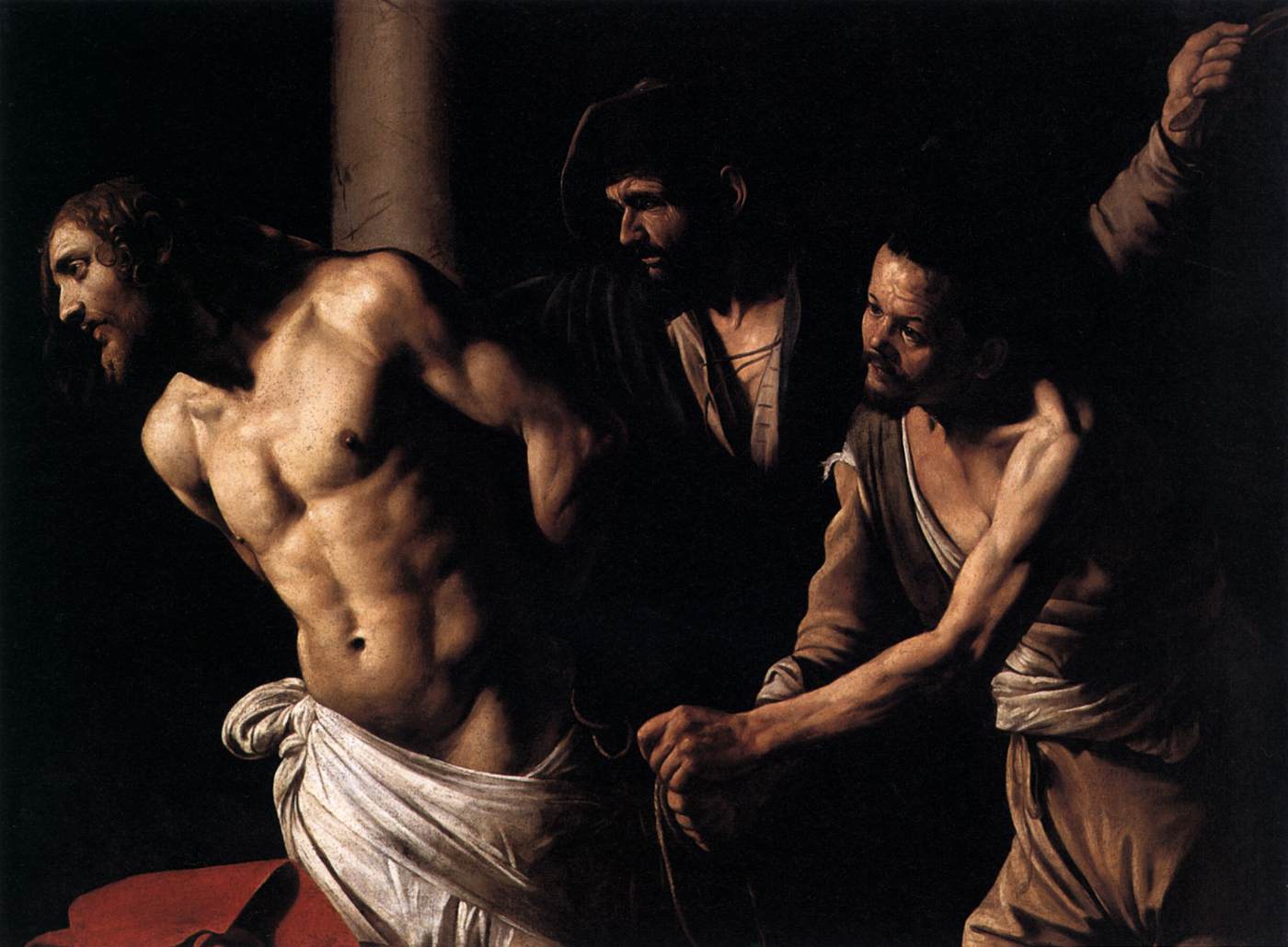
Flagellation - Caravaggio

This major painting, which (like the Seven Works of Mercy) dates from Caravaggio's first visit to Naples, is disquieting in its own special way. In May 1607 he was paid by Tommaso de' Franchis for an altarpiece to hang in the family chapel in San Domenico, where it stayed till 1972.

The atmosphere is so dense that the pillar before which Christ is being whipped can hardly be made out, but the handling of paint is so fluent that the cruel action taking place has its own powerful rhythm. The viewer is caught up in the horror.

The near-naked Christ is being twisted into position by the torturer on the right while the torturer on the left tears at his hair. At the bottom left a third tormentor stoops to prepare his scourge.

The composition is derived from a fresco by Sebastiano del Piombo, but its restricted palette of dismal colours gives it a grim force that few earlier paintings had equaled.

Source

Sunday, April 17, 2011

Saturday, April 16, 2011

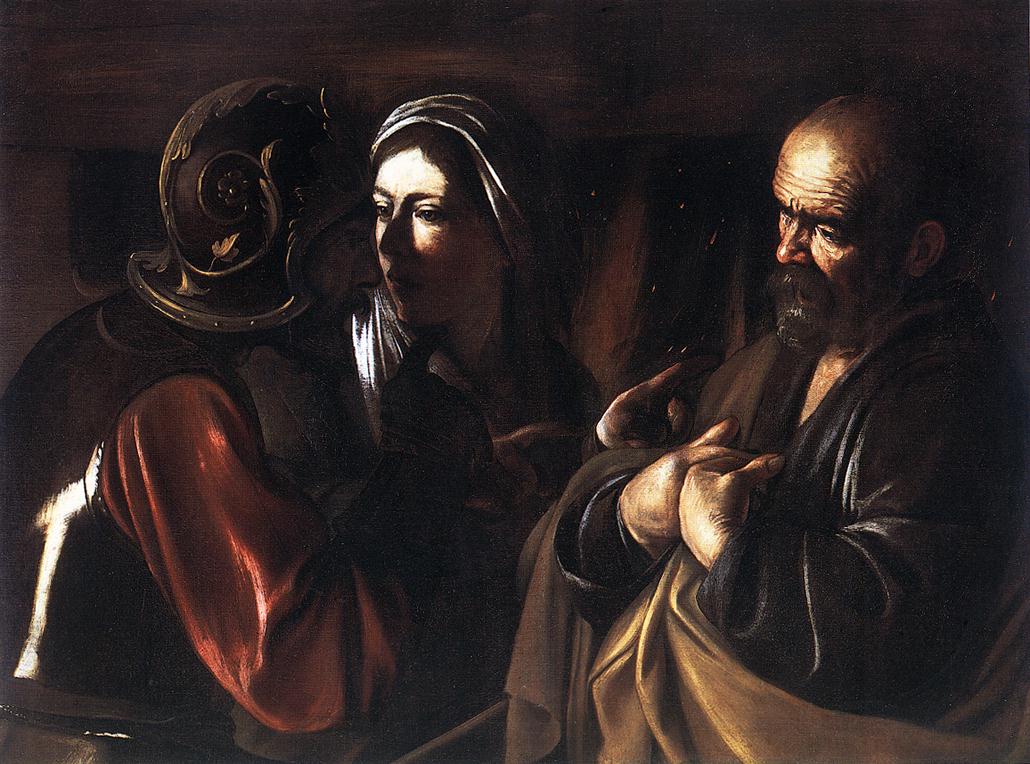
The Denial of Saint Peter - Caravaggio

After the artist's many attempts to intensify the dynamics of a scene from the right, this composition offers a dramatic sequence of figures from the left. On a very dark night with deep shadows and without any indication of artificial light, a soldier wearing a helmet and armor appears from the left. He is turning his face so far round to the maid that it gets swallowed up by the darkness. The maid herself, her face obscured by the soldier's shadow, is peering at the soldier from close quarters. She is pointing her left hand at St Peter, who is holding both hands against his chest in a gestion of confirmation. For the apostle, Caravaggio has chosen a model who would be ideal for an old satyr or for Socrates. The artist usually introduced heads like this for executioners.

The Web Gallery of Art suggests you listen to this piece by Palestrina while contemplating this moving work.

Friday, April 15, 2011

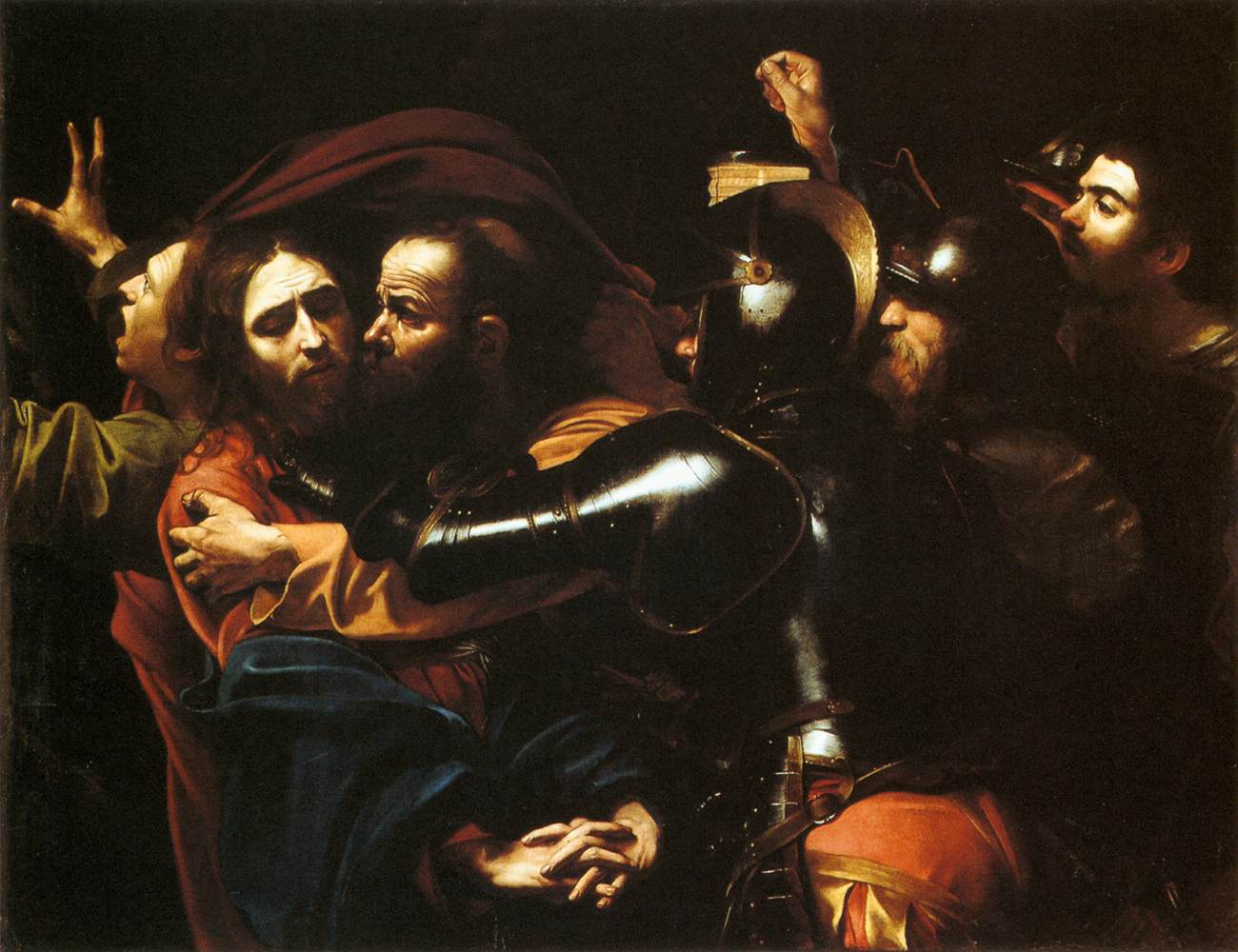
Taking of Christ - Caravaggio

The main figures are pushed to the left, so that the right-hand half of the picture is left to the soldiers, whose suits of armor absorb what little light there is, and whose faces are the most part hidden. At the right of the picture, an unhelmeted head emerges from the surrounding darkness. This is often regarded as the artist's self-portrait. Caravaggio has also concerned himself here with the act of seeing as one of a painter's task. The three men on the right are there mainly to intensify the visual core of the painting, underscored by the lantern. On the left, the tactile aspect is not forgotten. Judas vigorously embraces his master, whilst a heavily mailed arm reaches above him towards Christ's throat. Christ, however, crosses his hands, which he holds out well in front of him, whilst St John flees shrieking into the deep night. His red cloak is torn from his shoulder. As it flaps open it binds the faces of Christ and Judas together - a deliberate touch on the artist's part.

Thursday, April 14, 2011

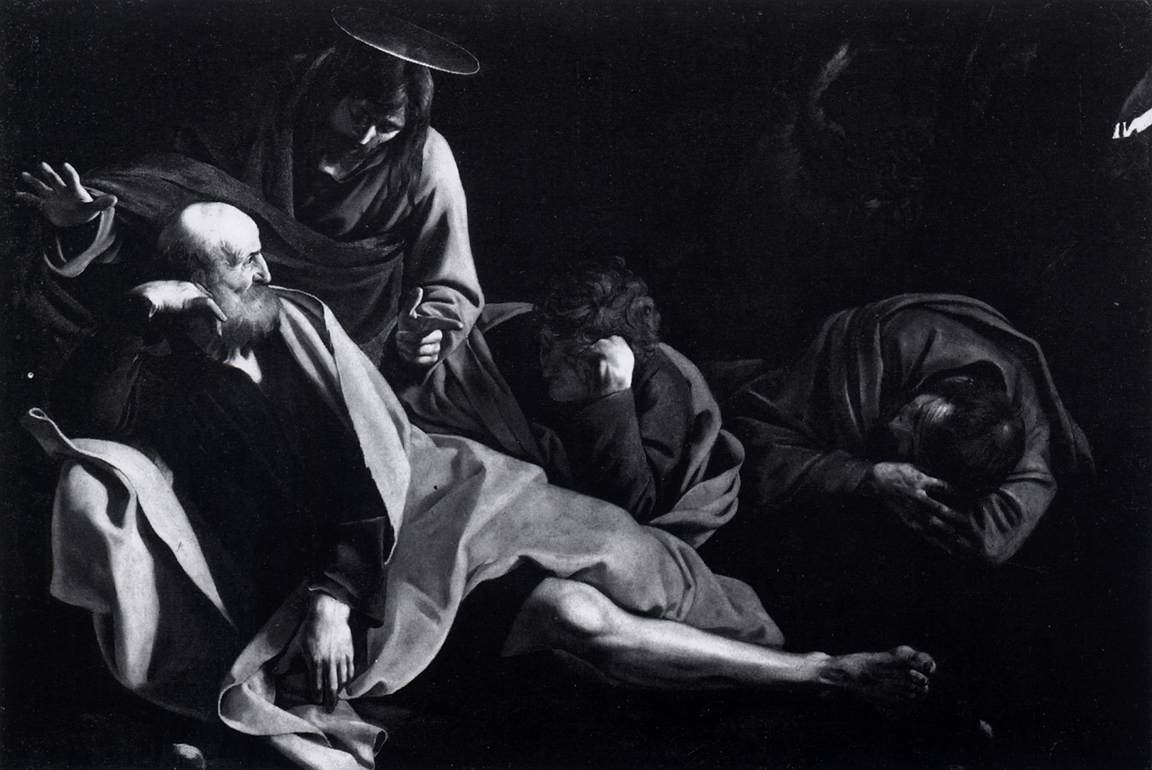
Christ in the Garden - Caravaggio


The painting was destroyed in the Second World War, it is known to us today through extant black and white photographs. This was a wonderful composition that caught the instant in which Christ awakes the sleeping apostles. The construction of the scene descends toward the lower right corner. St Peter in particular is shown in a classical position (which has been called Carracci-like), with the containment that characterizes this moment in the artist's career.

Wednesday, April 13, 2011

Tuesday, April 12, 2011

The Fifth Sorrowful Mystery: The Crucifixion

Image credit: Crucifixion, Pierre-Paul Prud'hon
The Web Gallery of Art also suggests you listen to this piece by Bach as you're appreciating this painting.

Monday, April 11, 2011

The Fifth Sorrowful Mystery: The Crucifixion


Image Credit: The Crucifixion, Grunewald

The picture shows the central panel of the first view of the Isenheim Altarpiece.

Art for Grünewald did not consist in the search for the hidden laws of beauty - for him it could have only one aim, the aim of all religious art in the Middle Ages - that of providing a sermon in pictures, of proclaiming the sacred truths as taught by the Church. The central panel of the Isenheim altarpiece shows that he sacrificed all other considerations to this one overriding aim. Of beauty, as the Italian artists saw it, there is none in the stark and cruel picture of the crucified Saviour. Like a preacher at Passiontide, Grünewald left nothing undone to bring home to us the horrors of this scene of suffering: Christ's dying body is distorted by the torture of the cross; the thorns of the scourges stick in the festering wounds which cover the whole figure. The dark red blood forms a glaring contrast to the sickly green of the flesh. By His features and the impressive gesture of His hands, the Man of Sorrows speaks to us of the meaning of His Calvary.

His suffering is reflected in the traditional group of Mary, in the garb of a widow, fainting in the arms of St John the Evangelist, to whose care the Lord has commended her, and in the smaller figure of St Mary Magdalene with her vessel of ointments, wringing her hands in sorrow. On the other side of the Cross, there stands the powerful figure of St John the Baptist with the ancient symbol of the lamb carrying the cross and pouring out its blood into the chalice of the Holy Communion. With a stern and commanding gesture he points towards the Saviour, and over him are written the words that he speaks (according to the gospel of St John iii. 30): 'He must increase, but I must decrease.'

There is little doubt that the artist wanted the beholder of the altar to meditate on these words, which he emphasized so strongly by the pointing hand of St John the Baptist. Perhaps he even wanted us to see how Christ must grow and we diminish. For in this picture, in which reality seems to be depicted in all its unmitigated horror, there is one unreal and fantastic trait: the figures differ greatly in size. We need only compare the hands of St Mary Magdalene under the Cross with those of Christ to become fully aware of the astonishing difference in their dimensions. It is clear that in these matters Grünewald rejected the rules of modern art as it had developed since the Renaissance, and that he deliberately returned to the principles of medieval and primitive painters, who varied the size of their figures according to their importance in the picture. Just as he had sacrificed the pleasing kind of beauty for the sake of the spiritual lesson of the altar, he also disregarded the new demand for correct proportions, since this helped him to express the mystic truth of the words of St John.

Sunday, April 10, 2011

The Fifth Sorrowful Mystery: The Crucifixion

Image Credit: Crucifixion Diptych (right panel) Rogier van der Weyden

Friday, April 8, 2011

Thursday, April 7, 2011

Wednesday, April 6, 2011

Monday, April 4, 2011

Sunday, April 3, 2011

Friday, April 1, 2011

The Third Sorrowful Mystery: The Crowning With Thorns

Image credit: Crowning with Thorns, Valentin de Boulogne